
Passaic Parole and Probation Compared
Parole normally follows a state custodial sentence and is administered by the New Jersey State Parole Board, or SPB. Probation is imposed by a court and administered through the New Jersey Judiciary. That split matters in Passaic County because a person arrested here may be processed in Wayne, housed in Bergen or Hudson County, and later committed to the New Jersey Department of Corrections. None of those moves proves that supervision has begun.
A release record answers when one agency’s custody ended. It does not always show whether a separate supervision term remains active. The court judgment is the sound public source for a probation sentence. NJDOC history may show that a person was paroled, but NJDOC warns that its released and paroled entries are not updated after departure. Current parole status should therefore be checked with SPB.
| Point | Parole | Probation |
|---|---|---|
| Authority | New Jersey State Parole Board | New Jersey Judiciary |
| How it starts | Conditional release tied to a custodial sentence | A sentence or court order |
| Public starting record | NJDOC custody history and SPB information | Judgment of Conviction or public case docket |
| Current status route | SPB Public Information Office | Client portal for the supervised person; public details are restricted |
| End point | SPB discharge or sentence-related end of supervision | Court/Judiciary completion or discharge record |
- Parole
- Conditional community supervision after release from a custodial sentence.
- Probation
- Court-ordered supervision that is distinct from parole and may be imposed without a state-prison release.
- Discharge
- The formal end of an agency’s custody or supervision, depending on the record.
- Absconder
- A person alleged to have stopped reporting or otherwise left supervision without authorization.
Verify Passaic Post-Release Supervision
Begin with the custody and case facts, not a guess based on where the person once appeared online. Passaic County has no overnight jail. Adults may leave the Wayne short-term processing site after court or transfer to Bergen or Hudson. A later state sentence moves the inquiry to NJDOC. The sequence identifies which agency could hold the supervision record.
Use the following order for a named person. It keeps an old parole event, a probation sentence, and a current warrant from being treated as the same fact.
- Review the New Jersey Judiciary PROMIS/Gavel public criminal portal for the Passaic case, judgment, sentence, and public probation information.
- If the judgment imposed state prison, check the NJDOC offender search for incarceration history, Date Out-of-Custody, and a parole event.
- For current parole verification, send the narrow inquiry to SPB Public Information at SPB-Public-Info-Office@spb.nj.gov.
- For probation, recognize that the Probation Client Portal is authenticated self-service. It is not a public name search.
- If a releasable agency record is needed, use the SPB OPRA form or the correct Judiciary records process and identify the person and case precisely.
The full release episode may still require a dated record from Wayne, Bergen, or Hudson. That record establishes how physical custody ended, while the court or SPB record addresses supervision. The broader Passaic County released-inmate search and records path explains how those records fit together.
Important: A prior “paroled” label in NJDOC is historical. It does not prove that New Jersey parole supervision remains active today.
Note: Public confirmation may be limited to the releasable status, without an officer’s schedule, address, or other protected supervision details.
No Public Passaic Supervision Lookup
New Jersey has no verified public name-search tool that gives current parole or probation status for any person. An NJDOC record may preserve an old parole event, but the department says released and paroled records are not updated after departure. That makes the entry useful history, not a live supervision roster. SPB Public Information is the direct route for a narrow current-parole inquiry.
Probation has a different access limit. The Probation Client Portal lets the logged-in client view the assigned officer, office, contact details, and next appointment. It does not let the public search by someone else’s name. Judiciary form CN 10598 identifies adult probation and pretrial records as confidential under Court Rule 1:38-3(d)(12). The public judgment may establish that probation was imposed even when current reporting and compliance details remain closed.
An empty search therefore proves little. Use the public court judgment for the legal sentence, SPB for current parole, and the holding agency for the dated physical release. Each source answers a different question.
Passaic Parole and Probation Contacts
Parole questions are handled at the state level. Probation is a Judiciary function with a Passaic County office. The office serving a person should not be inferred from the county of arrest alone, since placement and supervision can change. Use the current directory when routing a probation inquiry.
New Jersey State Parole Board
PO Box 862
Trenton, NJ 08625
Street office: 171 Jersey Street, Building 2, Trenton
609-292-4257
SPB-Public-Info-Office@spb.nj.gov
Passaic County Probation
55 Dale Avenue
Paterson, NJ 07505
Judiciary directory/main: 973-653-2910
SPB publishes separate unit contacts for release, parole, legal support, and revocation. A caller should state the narrow issue so the board can route it. Probation clients can use their authenticated portal to view an assigned officer, contact details, next appointment, and office. Those client tools do not create a public lookup for someone else.
Passaic Parole Eligibility Records
The SPB public schedule substitute is a rolling Parole Eligibility notice, not an appointment calendar. Its statewide notice groups people by county and invites public comment. Fields can include name and SBI number, jail credit, sentence date and judge, sentence or mandatory minimum notation, location, offenses, indictment, aliases, and at times a release, revocation, or return notation.
The notice shows who is expected to receive consideration. It does not show a fixed hearing appointment or prove an outcome. No public searchable SPB grant-or-deny decision database was identified. A named result therefore needs a direct inquiry to SPB or a focused request for a releasable record.
The SPB hearing process starts with review by a Division of Release hearing officer. A two-member panel may grant or deny parole. A denial results in a Future Eligibility Term, often called an FET. A grant may add special conditions and set a future release, but new adverse information can lead to rescission before departure. A later alleged violation can produce continuation or revocation proceedings. Eligibility, a grant, and an actual release are three separate events.
The official SPB hearing-stage page shown in the manifest illustrates why the event labels must be read in sequence.
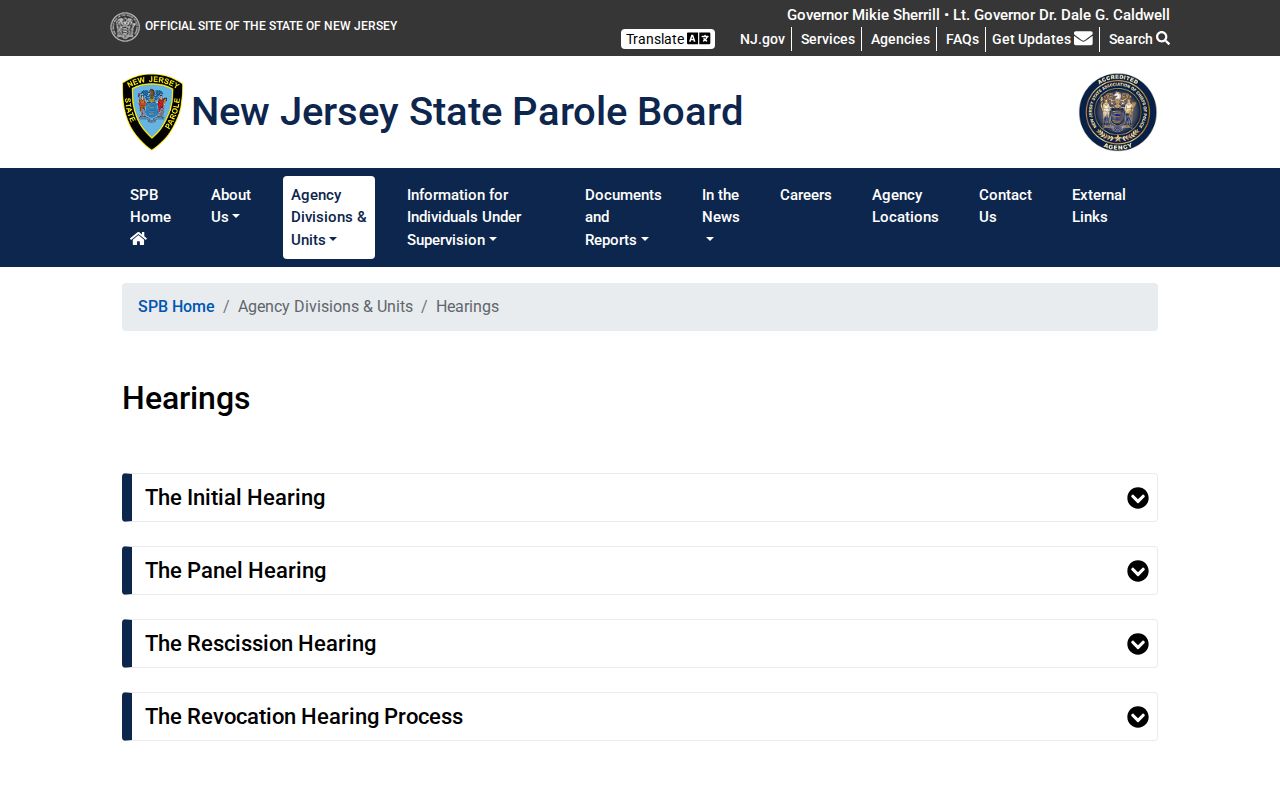
The state’s process description supports an outcome inquiry, but the final release fact still comes from Date Out-of-Custody and the responsible agency record.
Passaic Supervision Violations and Warrants
Conditions are the rules attached to supervision. A violation may involve alleged noncompliance, but it is not automatically a new criminal conviction. Parole revocation, a parole warrant, a probation violation, a bench warrant, and a new charge are distinct legal events. Each has its own issuing authority and record path.
SPB provides an anonymous fugitive-tip email at SPB-Fugitive-Tip-Submit@spb.nj.gov. No verified statewide public name-searchable parole absconder list was found. The Passaic County Sheriff Warrant Division executes arrest, bench, and civil warrants and coordinates fugitive work, but its page is not a public warrant lookup. It also cannot establish whether a person is on parole.
If a custody change follows an alleged violation, check the new court event or SPB record and the actual holding agency. New Jersey VINE may send a custody-change alert when a participating agency reports one, yet an alert is not a warrant record or a certified supervision finding.
Note: Treat a warrant tip channel as a reporting route, not as proof that a named person has an active warrant.
Passaic Reentry After Release
Release and supervision records answer legal-status questions. They do not provide all forms of practical aid. Purpose-neutral local navigation includes the New Jersey Reentry Corporation’s Passaic office, the NJDOC Passaic County resource guide, and Passaic County Human Services. These channels can help connect a person with identification, health and behavioral-health services, legal services, mentoring, and county programs.
New Jersey Reentry Corporation, Passaic
66 Hamilton Street, Suite 201
Paterson, NJ 07505
551-256-9062
Monday through Friday, 9 a.m. to 5 p.m.
Passaic County Human Services
401 Grand Street, Room 506
Paterson, NJ 07505
973-881-2834
These programs do not verify parole, probation, or release. SPB, the Judiciary, and the custody agency remain the record sources. Keeping those functions separate prevents a service referral from being mistaken for an official status confirmation.
Passaic Property After Release
Passaic County’s shared-services model creates a local property issue. The Sheriff says personal property accompanies a transferred person to Bergen or Hudson. After transfer, the receiving facility handles retrieval tied to its custody. A person who left Wayne is therefore not always dealing with Passaic for property.
If property may remain with Passaic, first contact the current facility. Under the Sheriff’s transferred-property policy, the confined person must verify and approve a release request before staff provides the instructions. A past transfer or discharge record can help identify which agency last held the person and property.
This process is separate from supervision. A probation office or parole officer is not the property custodian merely because the person reports there after release.
Passaic Supervision Discharge Records
Supervision ends through the authority that imposed or administered it. For parole, a current SPB response or releasable discharge record is stronger than a stale NJDOC entry. For probation, look to the court and Judiciary record, subject to confidentiality limits. Court Rule 1:38-3(d)(12) treats adult probation and pretrial-services records as confidential, so a public requester may not receive compliance details or a full client file.
NJDOC’s record can still be useful for the custodial history. Date Out-of-Custody answers when the person left that NJDOC episode. Current Max Release Date is a changing sentence calculation. Current Parole Eligibility Date is an expected eligibility point. None of those fields alone proves current parole discharge.
When asking for a record, identify the full name, SBI or case number if known, and the precise status or date sought. Ask for an existing releasable record rather than requesting that staff investigate or explain the person’s full history. This focused approach fits both OPRA practice and the privacy limits around supervision.
Record rule: Use the court for probation, SPB for current parole, and the former custody agency for the physical release date.
Note: A supervision discharge and a physical release may have different dates because they close different parts of the legal record.