
Passaic Projected and Actual Release
A projected date is a calculation made before release. It can reflect the court sentence, jail credit, mandatory minimum, earned credits, forfeitures, and later adjustments. An actual release date records when a custody episode ended. In the New Jersey Department of Corrections offender search, the actual field is Date Out-of-Custody. The projected maximum field has a different official name: Current Max Release Date.
Passaic County adds another layer because it has no overnight jail. A person may be processed at the Wayne short-term site, then discharged after court or transferred to Bergen or Hudson. A transfer date ends one stage, not all custody. If the person is later committed to NJDOC, the state calculation applies. If the person remains a pretrial county detainee, there may be no sentence-based release date to calculate at all.
Scheduled versus actual: Current Max Release Date and parole eligibility are forecasts or decision points. Date Out-of-Custody is the completed NJDOC event.
A court order can explain why release should occur, but another hold or transport step may delay the physical event. For that reason, the judgment and the holding agency’s final custody record should be read together.
Find a Passaic Projected Release
Start by deciding whether the person is pretrial, serving a short county sentence, or serving a state-prison sentence. The county of the criminal case does not by itself identify the current custodian. A Passaic remand may be physically held in Bergen or Hudson, while a sentenced state prisoner is recorded by NJDOC.
- Review the Passaic court case in the PROMIS/Gavel public criminal portal for the disposition, sentence, jail credit, and any mandatory minimum shown publicly.
- Use the Sheriff’s official custody-routing page to determine whether a county remand went to Bergen or Hudson.
- For a state sentence, search NJDOC by name and identifiers, open the detail record, and confirm County of Commitment and the custody episode.
- Read Current Max Release Date and Current Parole Eligibility Date as distinct projected fields.
- For a county sentence, request the judgment, jail-credit entry, and the Bergen or Hudson calculation from the actual custodian.
- Confirm release only when Date Out-of-Custody or the final county discharge record records the completed event.
The general Passaic County release-record search provides the full route for Wayne, partner-county, state, federal, and court records when the custody class is unclear.
Note: A present date field can change, while an absent live-roster row cannot prove release or identify a transfer destination.
Passaic NJDOC Release Date Fields
NJDOC’s Offender Search Engine Help defines the fields that matter. County of Commitment identifies where the person was tried, convicted, and sentenced, usually the county of the offense. It does not mean the person is housed in that county. For a Passaic County prosecution resulting in state prison, it helps connect the NJDOC record to the local case.
| NJDOC field | Meaning | How to use it |
|---|---|---|
| Date In-Custody | The start shown for the state custody episode | Match the incarceration history to the sentence |
| Date Out-of-Custody | The defined date released from NJDOC custody | Use as the strongest online actual-release indicator |
| Current Max Release Date | The latest calculated maximum endpoint after earned and lost days | Treat as a changing projection |
| Current Parole Eligibility Date | The latest expected eligibility point under SPB calculation policy | Do not call it a parole grant or actual release |
| Maximum term and minimum | The sentence boundaries and any required minimum | Read with the judgment, counts, and credits |
| Incarceration history | Prior and current custody episodes | Do not mix a completed episode with a later return |
The official NJDOC help page captured in the manifest distinguishes Current Max Release Date, Current Parole Eligibility Date, and Date Out-of-Custody.
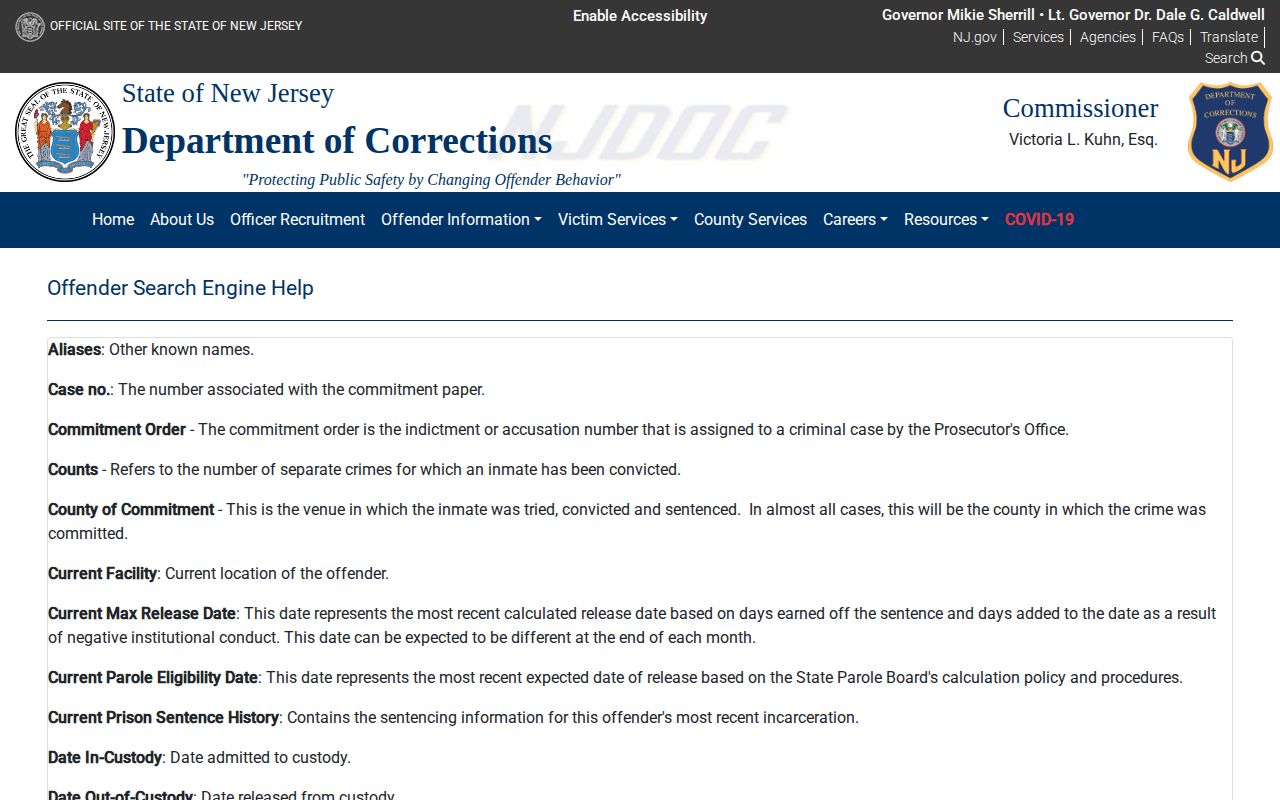
The field definitions prevent an eligibility date or projected maximum from being reported as though the person has already left custody.
NJDOC says the search updates biweekly and may not reflect work release, furlough, or residential community status. Released and paroled records are not updated after departure. Most records are removed one year after custodial-term completion, with specified continuing supervision records treated differently. Save a dated result, then seek the agency record when exact timing matters.
Passaic County Sentence Calculations
A short county sentence is not calculated by copying state-prison credit rules into a jail estimate. Use the Passaic judgment, the court’s jail-credit entry, and the computation maintained by the actual holding agency. Bergen usually confines male Passaic remands. Hudson usually confines female Passaic remands and may hold males as operations require.
The Passaic Sheriff Corrections Division describes one same-day route at Wayne: an eligible morning admission may remain for court, then transfer or begin discharge processing. It publishes no promised discharge hour, weekend-release rule, or fixed transport schedule. That path is driven by the day’s court result and any other holds, not by a public projected-date calculator.
No Passaic county-jail good-time rule or weekend-release statute was located in the research. None should be inferred. If the person is serving a Bergen- or Hudson-administered county term tied to a Passaic case, ask that custodian for the existing sentence calculation and final release record. If a transfer to NJDOC appears, the person remained in custody and the state fields become the right source.
County calculation: Judgment plus jail credit plus the holding agency’s computation is the proper route. State-prison credits cannot be imported by assumption.
New Jersey Release Date Credits
NJDOC describes several parts of the state-prison calculation. Commutation credit, often called good time, can reduce the term and can be forfeited for institutional misconduct under New Jersey sentencing law and N.J.S.A. 30:4-140. Work credit is generally one day for each five days worked, including qualifying vocational or mandatory educational work, under N.J.S.A. 30:4-92.
The NJDOC family guide also describes minimum or community-custody credit as three credits per month during the first twelve months and five per month after that. Court-awarded jail credit, sentence structure, mandatory minimums, earned credit, forfeited credit, and later orders all affect the record. NJDOC administers sentence and credit calculations under N.J.A.C. 10A:9-5.1 et seq.
The calculation can be expressed only as a concept:
Judicial maximum term minus applicable court and correctional credits, plus forfeitures or adjustments, but never earlier than an applicable mandatory minimum.
This is not a do-it-yourself promise. Counts can run together or apart, court credits may be changed, and the current institutional record may include facts not visible in a public case page. The official Current Max Release Date is safer than private arithmetic, but it still remains a projection.
Note: Good time can move a state maximum date, but it does not automatically erase a mandatory minimum or establish parole release.
Passaic Release Dates Under NERA
The No Early Release Act, N.J.S.A. 2C:43-7.2, requires an 85 percent parole-ineligibility minimum for an enumerated first- or second-degree offense, including a covered attempt or conspiracy. It is not an 85 percent rule for every New Jersey prisoner. The conviction, degree, and statute in the judgment determine whether NERA applies.
When NERA applies, the court sets the required parole-ineligibility term. Correctional good, work, and custody credits do not move parole release earlier than that mandatory minimum, though permitted court-awarded credit is part of the sentence record. The statute also provides specified post-release supervision terms for covered cases.
Ordinary parole law follows a different baseline. Under N.J.S.A. 30:4-123.51, primary eligibility generally arises after a mandatory minimum or one-third of the sentence when there is no mandatory minimum, subject to the statute and authorized credits. The live statute and the actual judgment control. A broad “serve 85 percent” estimate can be wrong by both offense and sentence.
Why Passaic Release Dates Change
A date can move because the facts used in the calculation change. Some changes affect the maximum sentence endpoint. Others affect eligibility or whether a person can physically leave. These should not be collapsed into one generic delay.
| Factor | Possible effect | Record to check |
|---|---|---|
| Earned credits | May move Current Max Release Date earlier within governing limits | NJDOC sentence calculation |
| Misconduct forfeiture | May add days back and move the projected maximum later | NJDOC calculation and releasable disciplinary result |
| Corrected jail credit | Changes credit for eligible prior custody | Court order and updated agency calculation |
| New or amended order | Can alter sentence structure, count, or term | Passaic judgment and later court orders |
| Detainer or another hold | May prevent community release or cause a handoff | Final custody record and receiving agency locator |
| Parole decision | Grant can schedule release; denial sets a Future Eligibility Term | SPB record and Date Out-of-Custody |
| Rescission before departure | Can undo a scheduled parole release after new adverse information | SPB hearing or decision record |
A detainer deserves special care. A person can be released by Bergen or Hudson to ICE or another authority and still not return to the community. Likewise, a county-to-NJDOC transfer ends the county episode without ending confinement. Ask the releasing custodian for the destination, then check the receiving system.
Passaic Parole Eligibility and Release
Current Parole Eligibility Date starts a decision track. It is not a booked departure time. The New Jersey State Parole Board’s process includes review by a Division of Release hearing officer and action by a two-member panel. A denial can produce a Future Eligibility Term. A grant can impose conditions and schedule a later release.
Even a grant is not the last fact. New adverse information can trigger rescission before the person leaves. The final online custody evidence is still Date Out-of-Custody, followed by current SPB information if supervision status matters. NJDOC’s old “paroled” label may remain static after departure and should not be used to prove current active parole.
The SPB rolling eligibility notice lists people expected to receive consideration and may include Passaic entries. It is not a precise hearing calendar or decisions database. For a named outcome, contact SPB Public Information or seek a defined releasable record.
Passaic Release Channels by Custody
Confirmation depends on the custodian. For a Wayne same-day discharge, obtain Passaic’s final processing or discharge entry and compare the court disposition. For a person physically released from Bergen or Hudson, obtain that partner county’s final out-of-custody record. A Passaic file may show commitment and transfer but not the later door time at the partner jail.
For a state prisoner, preserve the NJDOC Date Out-of-Custody and incarceration-history episode. If parole applies, check current supervision with SPB. New Jersey VINE can send a custody-change notice for participating county and state sources, but an alert may lag and a transfer can also trigger an event. The Passaic County VINELink inmate search explains how to register and read that notification without overstating it.
For federal custody, use the BOP Inmate Locator. A past date with `RELEASED` confirms the end of BOP custody but not the end of every other legal obligation or custody. For ICE, use the Online Detainee Locator and its information line when needed. A negative result in either a current system is weaker than an affirmative dated record.
When requesting the final record, identify the full name, date of birth, SBI or booking number, booking date, and Passaic case if known. Ask for booking or admission time, final out-of-custody date and time, release authority or type, transfer destination, and final custody disposition. The precise record closes the gap between a forecast and what actually happened.
Note: The correct release channel follows the person’s actual custodian, not just the county where the criminal case began.